Pre-launch pricing: $70 — through December 31
S3: The Structured Signal System
The System for Founders Who Aren't Marketers
Turn your customer knowledge into the signal Andromeda is wired to reward.
Something shifted.
Your campaigns used to be predictable. You'd find a winning ad, scale it, and let it run until creative fatigue set in. When performance dropped, you'd refresh creative or adjust targeting. It worked.
Now? Winners decay faster. Targeting changes don't stick. You've tried "more creative" and it didn't help. You've tried going broad and trusting the algorithm—the results are volatile.
You're not worse at this. The game changed.
In late 2024, Meta rolled out something called Andromeda—a complete rebuild of how ads get matched to people. Not a tweak. A new architecture.
If you've felt like the rules stopped making sense, that's why. And once you understand what Andromeda actually rewards, you can stop fighting the algorithm and start feeding it what it wants.
The Mechanism
What Changed
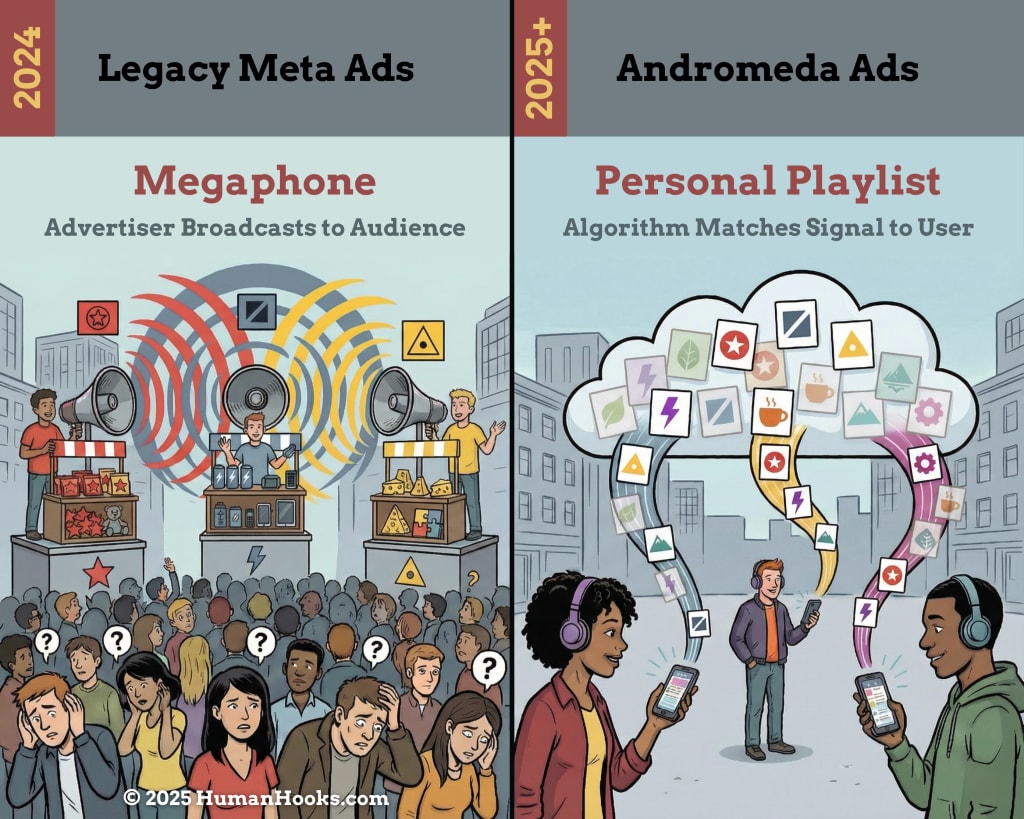
The old system rewarded targeting precision. You'd define an audience, Meta would deliver to it. The skill was in segmentation—stack the right interests, find underpriced audiences, out-target your competitors.
Andromeda inverted this.
Now Meta's AI decides who sees your ads based on signals it reads from your creative. Your targeting inputs are suggestions. The algorithm overrides them when it thinks it knows better—and increasingly, it does.
This is why "go broad" became the advice. But here's what that advice leaves out:
The algorithm can only work with what you give it.
If you're feeding it three ads with the same underlying message, you're asking it to solve an equation with missing variables. You get volatility—because the system is guessing.
What Andromeda actually rewards is signal diversity—different messages, angles, and contexts that let the AI match the right ad to the right person.
Not more ads. Different signals.
That's a structure problem, not a volume problem.
The Signal Andromeda Wants
Here's what most marketers miss:
The signal Andromeda rewards isn't creative cleverness. It's customer knowledge.
Who are your customers? What situation triggers their need? What objections do they have? What would make them act now vs. later?
That's knowledge you have. You understand your customers' problems, motivations, and hesitations better than any agency ever could. You live in your market. You talk to customers. You know what they're thinking.
You just don't have a way to translate that knowledge into something the algorithm can use.
That's the structure problem S3 solves.
You're not competing on creative talent. You're competing on customer insight—structured into signal diversity.
What's Inside
What's In S3
A complete system for translating what you know about your customers into signal diversity—structured for how Andromeda actually works.
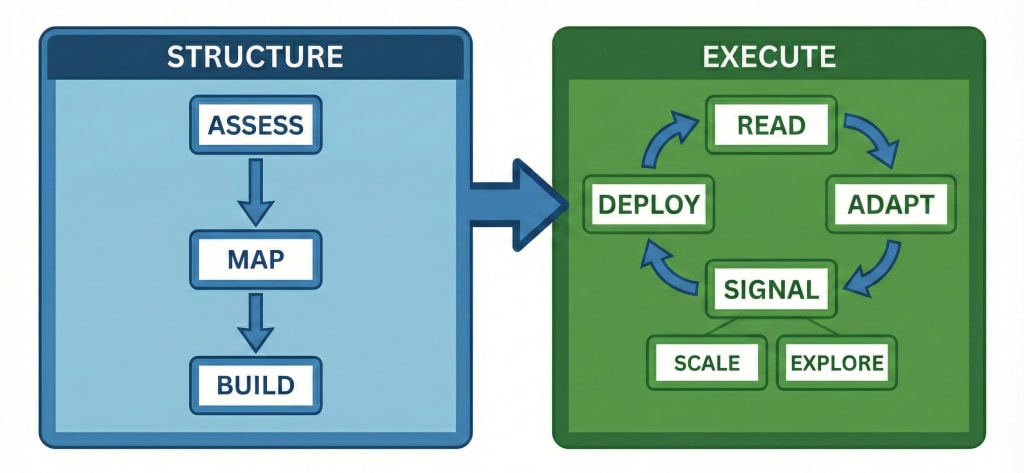
The Signal Diversity Map
Guided process to build your signal diversity plan. Not generic "test more ads" advice—a custom blueprint for your brand, scaled to your production capacity.
You'll finish with a document showing exactly which variations to produce, in what order, at what cadence.
The Architecture Playbook
Campaign structures for your spend level. Budget allocation frameworks. Migration paths if you're restructuring existing campaigns.
Includes production SOPs and AI prompts you can hand to a VA or contractor—so this doesn't become another thing you personally manage forever.
The Diagnostic Framework
When performance drops—and it will—this identifies exactly what's wrong.
Checklist for isolating the problem. Protocol for fixing root cause instead of panic-tweaking and hoping.
The Algorithm Decoder
Optional deep-dive for those who want first principles.
How Andromeda, GEM, Lattice, and Sequence Learning actually work together. What the engineering documentation says—translated into strategic implications.
For founders who want to reason from the mechanism, not just follow the framework.
Who Built This
I spent most of my career as a CTO, not a marketer. Sold a software company to a Fortune 500. Later shifted to CMO and took a company to a Nasdaq IPO.
When I moved into marketing, I brought systems thinking. $75 million in first-party Meta spend—my money, my P&L. More than $220 million in Meta-attributed revenue. Six 8-figure brands. Two Inc. 500 awards.
All from treating marketing as an engineering problem, not a creative one.
But that was on the old system.
When Andromeda broke everything, I went to the source—Meta's engineering and architecture resources, not their advertising documentation. I could read it because it's written for engineers. That's what I am.
S3 is what I rebuilt for how Meta actually works now.
Why I Built This
I'm a technical founder who figured out marketing through systems thinking and lots of experimentation with my own campaigns. Was never a natural marketer, but got good enough to make it a consistent growth lever instead of a bottleneck.
When Andromeda changed the rules, I had a choice: figure out the new system, or keep running the old playbook and watch it decay. I figured it out.
S3 is the framework I built—for founders who think in systems, not slogans. Builders, not marketers. Founders who want to understand the logic, not just follow tactics. Who'd rather solve marketing once than manage it forever.
What I Specifically Didn't Build
I didn't build a beginner's course.
If you haven't run Meta ads profitably before, start there. S3 assumes you have campaigns, conversion data, and a working offer. The problem it solves is structural, not foundational.
I didn't build an agency playbook.
If you're running ads for clients, you might learn something—but I built this for operators with their own money at risk, making decisions for their own business.
I didn't build a quick fix.
Andromeda's learning phase is real. If you can't let a campaign run for a week without tweaking it, this framework will fight you. The system requires patience.
I didn't build "done for you."
S3 is operator knowledge. You'll understand the system, build your structure, and make your own decisions.
Get S3: Structured Signal System
Pre-launch pricing through December 31. Full price January 1: $140.
Complete Access
Everything you need to structure your campaigns for how Meta actually works now. Signal diversity Andromeda is built to reward. One payment. Lifetime access. Updates included.
What's included
- The Signal Diversity Map
- The Architecture Playbook
- The Diagnostic Framework
- The Algorithm Decoder
- Complete SOP Library
- Prompts for AI Automation
- Lifetime updates
- 30-day refund guarantee
This is a pre-order — S3 launches January 1, 2026
One-time payment
$70USD
Pre-Order S3 @ 50% Off →30-day guarantee: If it's not useful, email me for a refund. No questions.